If you live in Fountain Hills, you know there is nothing quite like watching the world-famous fountain reach for the sky against the backdrop of the McDowell Mountains. Whether you are nestled in the heights of Eagle Ridge or enjoying a quieter spot near the downtown area, we live in a slice of paradise. But as any Arizona native can tell you, that paradise comes with a price: especially when the summer temperatures start climbing into the triple digits.
Does it feel like you are working just to pay your electric bill? You aren’t alone. Many homeowners in the 85268 and 85269 ZIP codes are literally venting money into the desert air without even realizing it. At Bucksworth Home Services, we see it every day. As a family-owned, Arizona-born company, we’ve spent years under the hoods of HVAC systems across Maricopa County. We know exactly where the “leaks” are: and I’m not just talking about water.
In this guide, I’m going to walk you through how to tighten up your home’s air envelope, optimize your insulation, and ensure your HVAC system is performing like a pro, not a liability.
Understanding Your Home’s “Air Envelope”
Think of your home like a giant cooler. If you leave the lid cracked even a tiny bit while sitting out at Fountain Park, the ice melts and your drinks get warm. Your home works the exact same way. The “air envelope” is the physical separator between the conditioned air inside your house and the scorching Sonoran Desert air outside.
In many Fountain Hills homes: especially those built during the expansion booms: this envelope is far from airtight. Small gaps around windows, doors, and where utility lines enter the home create a “chimney effect.” Hot air pushes in, and your expensive, cool air is pushed out.
Why the Envelope Fails in Fountain Hills
Fountain Hills has unique terrain. The elevation changes and the way wind whips through the canyons near Eagle Ridge can actually increase the pressure on your home’s exterior. This pressure forces hot air through even the smallest cracks.
What you can do today:
- Check the seals: Look at the weather stripping on your exterior doors. If you can see daylight through the cracks, you’re losing money.
- Caulk the penetrations: Check where plumbing or electrical lines enter the home. A simple can of spray foam or high-quality caulk can save you 5–10% on your cooling costs.
- Inspect the attic hatch: This is the most overlooked part of the air envelope. If your attic access isn’t sealed or insulated, it’s like having a window open to a 150-degree room.
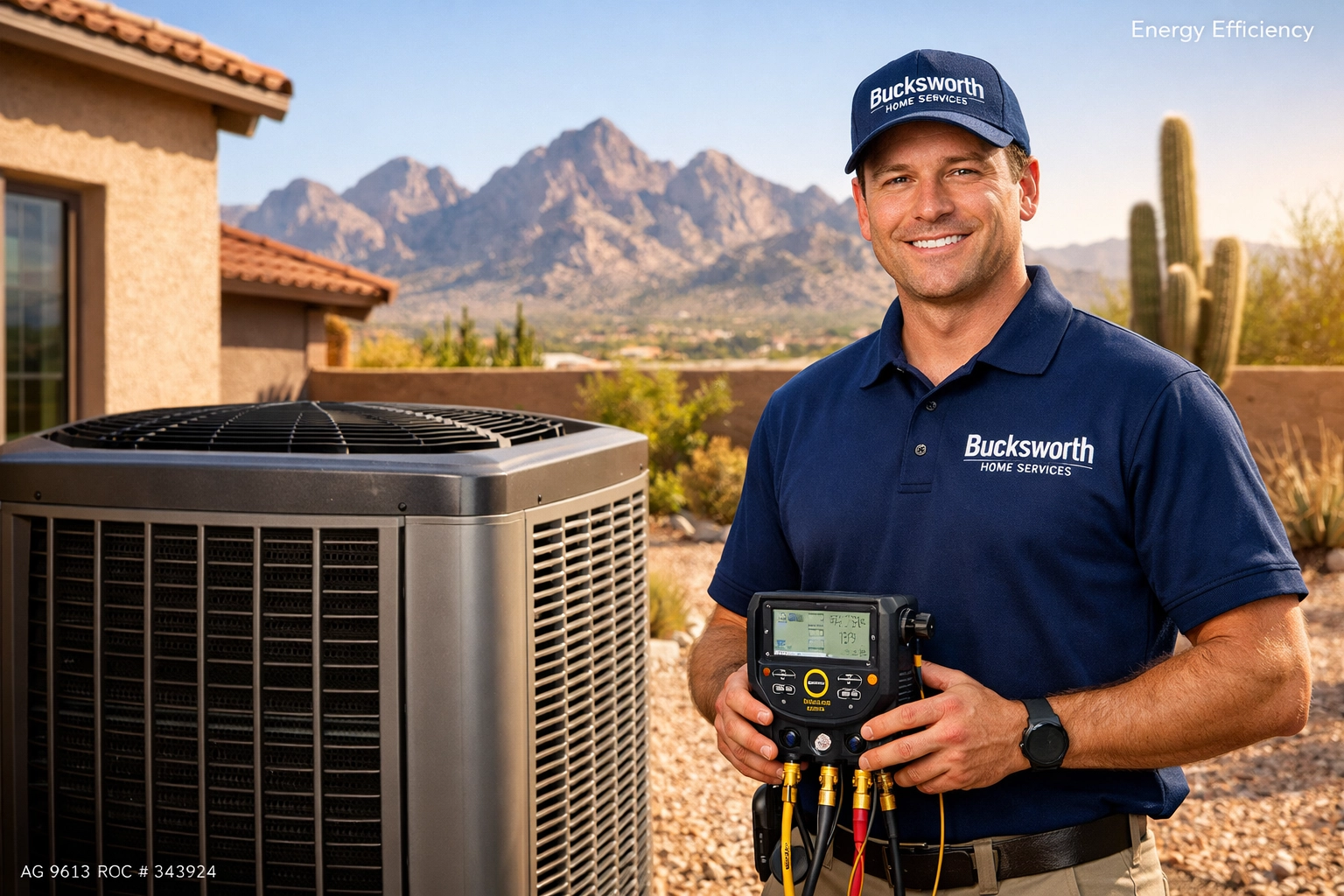
(A professional Bucksworth technician performing a comprehensive inspection of an outdoor AC unit to ensure peak efficiency during the Fountain Hills summer.)
The Truth About Attic Insulation
If the air envelope is the “cooler,” then insulation is the “styrofoam” inside. Most homes in Fountain Hills were built with blown-in fiberglass or cellulose insulation. Over time, this material settles. What started as 12 inches of protection might now only be 6 or 7 inches.
In Arizona, we measure insulation effectiveness by “R-value.” For our climate, the Department of Energy recommends an R-value of R-38 to R-60. Most older homes in the 85268 area are lucky to be sitting at R-19. This means heat is radiating through your ceiling and forcing your AC to work overtime.
The Radiant Barrier Advantage
In addition to traditional insulation, many high-efficiency homes in areas like Eagle Ridge benefit from radiant barriers. This is a reflective material installed in the attic that reflects thermal radiation (the sun’s heat) back out, rather than letting it soak into your insulation. When combined with proper air sealing, this can drastically reduce the load on your HVAC system.
HVAC Efficiency: Stop the “Bait and Switch” Maintenance
Your air conditioner is the heart of your home’s comfort. In Fountain Hills, it’s also the biggest energy consumer. However, there is a lot of bad advice out there regarding how to care for it.
At Bucksworth, we do things differently. We don’t believe in pushing unnecessary twice-per-year “tune-ups” that are often just sales calls in disguise. Instead, we focus on once-per-year professional system service that actually looks at the data.
What Real Maintenance Looks Like
A true professional inspection shouldn’t just be a quick spray of the coils. It needs to be a deep dive into the system’s vitals. Are you curious about what goes into a real check? You can see our HVAC maintenance inspection checklist here.
We focus on:
- Refrigerant levels: Too much or too little refrigerant makes the compressor work harder and use more electricity.
- Electrical components: Tightening connections prevents heat buildup and potential component failure.
- Airflow dynamics: We ensure your fan motor is pulling the correct amperage.
- Smart Monitoring: We provide smart thermostat monitoring systems that alert you (and us) the moment a system starts underperforming: before you get a $500 electric bill.
Ductwork: The Hidden Energy Thief
You could have the most efficient 20-SEER AC unit in the world, but if your ducts are leaking, it doesn’t matter. In the Phoenix East Valley, it is common for residential ductwork to leak 15% to 20% of the air it carries.
Think about that: for every $100 you spend on cooling, $20 might be going directly into your attic. This is why we specialize in Duct Sealing and Aeroseal. By sealing the ducts from the inside out, we ensure that every bit of cold air you pay for actually reaches your living room.
If your home has rooms that are always hotter than the rest of the house: common in the multi-level floor plans found in Fountain Hills: it’s often a duct design or leakage issue. In some cases, ductless ACs can improve indoor air quality and efficiency for those specific “hot zones” without needing to overhaul the entire system.
When to Consider Replacement
If your system is more than 10–12 years old and you’re seeing frequent repairs, it might be time to look at an upgrade. Modern systems are significantly more efficient than those installed even a decade ago. If you’re wondering if you’ve hit that point, check out these 3 telltale signs it’s time for a new AC.
The Bucksworth Home Services Difference
Bucksworth isn’t a massive national corporation. We are Arizona born and raised. We understand the specific challenges of keeping a home efficient in the desert. We are Mom Approved, family-owned, and trusted by thousands of your neighbors.
We believe in honesty and reliability. That’s why our HVAC memberships are designed to be simple and affordable.
- HVAC Membership: Starting at $9.99 per month.
- Includes: Once-per-year professional service, smart monitoring, no trip charges during breakdowns, and 10% off repairs or new equipment.
We want to be the team you trust for the long haul, not just the guys you call when things break. Our ROC # 343924 and 2000+ Five Star Reviews are proof that we put the customer first every single time.
Hyper-Local Tips for Fountain Hills Residents
- Monsoon Prep: The dust from our Arizona monsoons is brutal on AC coils. After a big storm, gently rinse your outdoor condenser with a garden hose (don’t use high pressure!) to keep the airflow clear.
- Solar Window Films: Given how much sun we get, especially on West-facing windows overlooking the valley, energy-efficient window films can reduce solar heat gain by up to 70%.
- Thermostat Settings: If you’re leaving for a day at the Salt River or hiking the McDowell Sonoran Preserve, don’t turn the AC off. Set it to 82–85 degrees. Cooling a “hot” house from scratch uses much more energy than maintaining a higher baseline.
Frequently Asked Questions (Fountain Hills Energy Edition)
Q: Why is my electric bill higher in Fountain Hills than in other parts of the valley?
A: Fountain Hills homes often feature vaulted ceilings and large windows to take advantage of the views. While beautiful, these features increase the volume of air that needs to be cooled and allow more radiant heat into the home. Proper insulation and duct sealing are critical here.
Q: How often should I really change my air filter in 85268?
A: During the peak of summer, you should check your filter every 30 days. If you have pets or if it’s been a particularly dusty month, you may need to replace it monthly to keep the airflow unrestricted.
Q: Does it matter where my outdoor unit is placed?
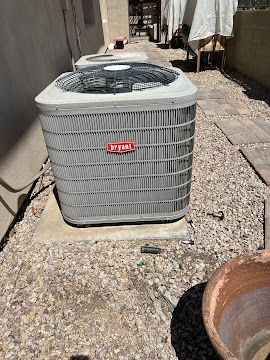
A: Yes! Units in tight side yards or those blocked by debris can’t “breathe” effectively. Ensuring at least 2–3 feet of clearance around your unit can improve efficiency significantly.
Q: Is a heat pump better for Fountain Hills than a traditional AC?
A: Heat pumps are incredibly efficient and work great in our climate. If you’re curious about the technical differences, you can read our guide on air conditioners versus heat pumps.
Get Your Bucksworth Today
Don’t let another summer of high utility bills drain your bank account. Whether you need a simple inspection, duct sealing, or a full system replacement, our team is ready to help you optimize your home for the Arizona heat.
Ready to start saving?
Call Bucksworth Home Services today at (480) 422-8388 to schedule your energy efficiency checkup. We’ve helped thousands of homeowners across Fountain Hills, Mesa, and Scottsdale lower their bills and increase their comfort.
Let’s make sure your home is as efficient as it is beautiful. Get Your Bucksworth!
Bucksworth Home Services
Arizona Pest Control License: AG 9613
Arizona Contractor License: ROC 343924
Family Owned & Operated since 2013